







|
|
|
|
|
|
Nightmare on the Diamond Bar
New Mexico ranchers Kit and Sherry Laney won awards for stewardship. As thanks for their good work, and thanks to the feds, Kit was jailed.
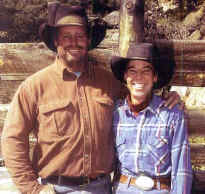
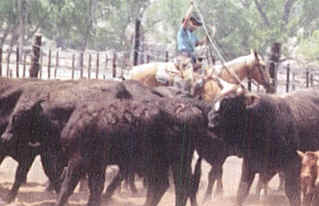
By Susan Christy It's been nearly 20 years since Kit and Sherry Laney first saw the Diamond Bar Ranch in southwest New Mexico. They were really just kids then, full of dreams they never suspected would become a nightmare. The years have aged them now beyond their still-young appearance of only 43 and 42. But it was not from the hard horseman's work on the roadless ground that crosses the Gila Wilderness. It wasn't the sacrifices they made of ordinary modern conveniences that tore them apart as a couple. It wasn't even the gut-wrenching bitterness they felt toward the unfair way they were treated that finally brought Kit to jail, held indefinitely as a political hostage. What has changed the once idealistic couple so deeply and forever are the legal betrayals that pile up higher around them than the fines they face for trespass on their own ranch. Intent on continuing their families' tradition of tending to cattle in Catron and Sierra county, Kit and Sherry, at 22, found the broken-down Diamond Bar unimpressive, but in their price range. Stressed by nature and previous tenants, plagued by periodic drought that left some areas mere tufts of grass on barren ground, the Diamond Bar held an 1860s' heritage, but a recent history of neglect. They thought they had the youth, endurance and optimism to improve and restore the range, and they were even encouraged by a Forest Service Memorandum of Understanding (MOU) for the ranch requiring water source development that would keep cattle further away from canyon streambeds. The Laneys made a low offer on the place that no one thought the bank would take, but it did. Diamond Bar Cattle Company and Laney Cattle Company were in business with a permit for 1,188 head in January 1986. Sherry remembers that even though they were asked to quit making improvements for a time because of environmental reviews, ranching on the Diamond Bar was a good life, full of optimism, until about 1993. Four years later, in 1997, they were forced to leave. Diamond Bar's wilderness area prohibits motorized vehicles on about 85 percent of the range. Elevations on the approximately 272 square miles of the ranch range from 6,000 feet along the Gila River's East Fork to Diamond Peak at 10,000 feet. Temperatures stretch from subzero cold in the high canyons to a low broil on the summer flats. Trails are steep, snow can be belly deep and scrubby vegetation is just all that's there in some places, with or without cows. It is a land of challenges. "You’re not going to get up in the morning out here and get in your pickup," says Sherry. "You're going to go saddle your horse and ride many miles every day." Ride, they did. The Laneys' perseverance on the Diamond Bar earned them an Excellence in Grazing Management Award from the New Mexico section of the Society for Range Management in 1993. Even the Forest Service acknowledged that forage on 98 percent of the ranch's grazeable acreage was in fair or better condition. The Laneys worked hard to keep it that way. After ash and sediment from fires choked creeks, they kept cattle off succulent regrowth to help the watersheds recover. Thick trees crowded grasses, drought endured, and no matter what—to those who only saw without understanding—the Laneys were attacked, their cattle held to blame. In retrospect, environmental advocates began protesting the presence of cattle on the Diamond Bar almost immediately, when conservationists of many stripes and agendas began to chafe at the fact that cows were on "their" public land. Silver City resident Susan Schock, admittedly uncomfortable among rough stock raisers in her newly adopted home, had a Forest Service friend over for dinner in 1987. He told her that the Laneys wanted to build stock tanks and mentioned that someone ought to do something about it, since it could be a violation of the Wilderness Act. Schock and her friend Mike Sauber formed Gila Watch to block construction, alleging that stock tanks would corrupt the value of the wilderness they claimed to know by vicarious sense.
Gila Watch placed a full-page ad in the Albuquerque Journal in April 1995 showing a bone-thin calf on a worn pasture and claiming that, "one rancher commands the use of 145,000 acres of the…wilderness through the ownership of only 115 acres of private land. "The ad coincided with New Mexico's congressional delegation lending an ear to a new form of grazing permit Kit Laney was drafting to recognize private rights to water and access to the land. In the urban population center of Albuquerque, the ad was received like it was a dolphin-free tuna campaign. Confronted with the implied opposition, the Forest Service refused to accept the Laneys" allotment proposal despite its merit based on direct study of the watershed. The fight was on. After they built the first two upland water sources, as required, by the Forest Service MOU in the late 1980s, the agency asked the Laneys to hold off on any improvements for a year so some environmental reports could be done. Then the Forest Service left Diamond Bar's MOU out of the Gila Forest Plan in 1986. That oversight necessitated an evaluation under the litigation-friendly National Environmental Policy Act (NEPA), which has been so successfully used by environmental organizations to reduce grazing on public lands that there is now a how-to guide for it on the Sierra Club website. The environmental evaluations, most open to wildly non-scientific public comments, meant that the Diamond Bar went without improvements—not for just the year, but until 1995 when the Laneys were abruptly told to reduce their herd to 100 head, a catastrophic reduction in their investment. After appeals and congressional intervention delayed that decision, a June 1995 Record of Decision authorized just 300-800 cattle and 20 horses. Appeals went to deaf ears.
By the time the Diamond Bar's grazing permit expired in 1996, the Laneys weren't very trustful of the Forest Service-the agency had not upheld its side of the contract. When their proposed alternative permit was denied, Diamond Bar Cattle Company (DBCC) filed suit against the United States, declaring the ranch as lawful owner of water and grazing rights on forestlands within the allotment. In April 1997, the Federal District Court ruled in favor of the U.S., dismissed the complaint and ordered the Laneys to remove their livestock and pay grazing fees for the unauthorized grazing during the litigation period. An appeal to the 10th Circuit Court of Appeals was lost. As the Laneys were hopelessly pursuing a fair look at their rights in court, the Forest Service called for no grazing at all on the Diamond Bar, supposedly due to "extreme overgrazing during the period that DBCC's lawsuit was being proved through Federal District Court." The decision left open the possibility of allowing for possible grazing of 300 cattle and 20 horses at an undetermined future point in time. The Laneys paid the fines and left the Diamond Bar in 1997. They tried to ranch for four years on a place down at Gila, then on two different ranches over at Logan. Sherry says it was six years of hell. Their living conditions were meager. Winters were spent in a summer cabin with no running water. There was nowhere that they could really call home. Both Kit and Sherry kept riding, trying to keep their stock alive and well so that someday they could go home. "We took them off, we paid all of the fines. They said they’d let it rest for three to five years," says Sherry. Fines were not the only thing that Kit and Sherry paid. They divorced in 2000 and Sherry broke down, emotionally and physically. "I went through a lot of physical problems that had just been building up, "she says. "I was so give out. I was depressed. Mainly, I stayed at my mom's for two years and I felt like all I did was sleep." Kit and Sherry kept in touch by phone, mostly because of their shared cattle. "The cows kept us together," Sherry says. "I didn’t want to get rid of my half and couldn’t find a lease, as dry as it was." Kit was there for Sherry when her sister and her sister's children were murdered in July 2001. They talked through many issues that had gone unnoticed or ignored, and finally they reconciled. Sherry admits ruefully that though she's built herself back up, she just can't work as hard or ride as hard as she used to. But there was trouble to come at the Diamond Bar. The Laneys filed for a permit for 300 head at the Diamond Bar three times from 2001 to 2003 and, each time, a denial letter came in the mail. "They never say why. They didn't even give us lip service," says Sherry. "Just that they wouldn't consider it at the time." Range and riparian experts called in to assess the Diamond Bar's suitability for grazing said the allotment was in good-to-excellent shape. Environmentalists dismiss these studies, saying the experts are rancher-friendly.
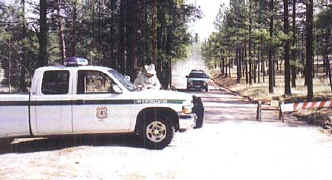
Neighbors have always been supportive, but one has been missing over the past few years. Gila Permittees Association President Laura Schneberger recalls that the Forest Service and ranchers "used to be neighbors. The Forest Service used to sit down with ranchers to write Annual Operating Plans. Now, they issue edicts that ranchers must comply with." If you listen for awhile, it’s readily apparent that the Laneys are by no means the only ranchers having problems dealing with unrealistic management from an agency that has chosen to favor environmental agendas rather than the people on its land. Especially targeted are those near the wilderness area, long considered to be a lynchpin in the formulated Wildlands Project meant to remove human presence from as much as one-third of the North American continent. In February 2003, Kit, Sherry and friends found hope in the case of Wayne Hage, who has successfully waged a 20-year battle for vested rights on his ranch in Nevada. Kit Laney and Wray Schildnecht, an exhaustive researcher, familiarized themselves with the Hage case, poring over law dictionaries and books on private property rights. It gave them hope that the Diamond Bar too might win in court someday. But Hage, in a coldly intellectual manner that few understand, usually cautions his followers to patience. The Laneys hardly had such time. At the time, Sherry says, "We were pretty tapped out. On one place, they gave us two weeks to pay double on our lease. There wasn't anyplace in the world with any grass, except the Diamond Bar. We thought, there's a world of grass out here, why don't we use it?" Armed with Hage's inspiration and working to simplify the matter of preexisting water, property and use rights, the Laneys disbanded the Diamond Bar Cattle Company and filed in Catron County for their rights in the form of a deed. Since the company had lost it all, Kit and Sherry's recourse was to form a warranty deed and file for their property as individuals. In April 2003, Kit and Sherry moved home to the Diamond Bar. One night, a local ranger called the house and said the Forest Service wondered what their intentions were. Sherry told him simply, "We intend to use our private property." Environmentalists began visiting the Diamond Bar and reporting what they saw as livestock damage to Gila Forest Supervisor Marcia Andre. In June, the U.S. Attorney's office filed to enforce the 1997 decision to remove cattle from the Diamond Bar due to a lack of permit. Federal Judge William P. Johnson ruled in Albuquerque in December 2003, that Diamond Bar Cattle Company, and Kit and Sherry Laney, were in contempt of the previous court order and gave them 30 days to remove their cattle. The ruling was good news for the National Wildlife Federation (NWF), Center for Biological Diversity, Gila Watch, New Mexico Wildlife Federation, Trout Unlimited and Wilderness Watch. After reactivating and updating their 1996 motion to intervene, which came too late that time, the groups asked for an injunction last fall for immediate cattle removal from the Diamond Bar. They were recognized as interveners just two days before the judge's December decision. Negative editorials about the Laneys and the range conditions on the Diamond Bar read word for word from environmental organization press releases. Claiming that the U.S. Attorney's trespass charge against the Laneys "didn't show the extensive damage being caused by cattle," NWF staff attorney Tom Lustig said, "we intervened to show the court that the ongoing trespass was causing substantial environmental damage." Pictures disagree. Gila ranchers say that environmentalists know just where to go to get the pictures that they want. Point the camera 100 yards in another direction, says Schneberger, and you"ll get thick, high grass. "One hundred yards from a tank, everything is fine. When you have cattle that need water, areas near it will get heavy use. Kit and Sherry tried to develop water sources to keep the cattle out, but they [environmentalists] sued." Pictures taken by the Center for Biological Diversity and their friends point to a cozy relationship with the Forest Service. After visiting South Diamond Creek for two days in July, the Center sent Andre photos of cows, noting "cow manure everywhere" and complaining of trails that were "pounded to fine dust with cattle hoof marks everywhere." Lustig crowed that once the Laneys are off the ranch, the agency would inspect for damage, tally the costs and charge Kit and Sherry for stream degradation, replanting of wild grasses and anything else they could find. The Forest Service has already done worse. The contractor they hired to impound the Laneys' cattle was no cowboy. Guarded by 40 or so armed Forest Service personnel, the ranch was crisscrossed by helicopters in early March searching for cattle. Roads and trails were blocked, the Laneys were watched as trespassers on their own ranch. Other ranchers went to the New Mexico Livestock Board to ask for help after word spread that no auction in New Mexico would sell the Laney cows. "That hearing was the first time I've ever seen all of the New Mexico livestock industry together on one issue," Sherry states. At issue was the MOU that Dan Manzanares, the board's executive director, signed with the Forest Service, authorizing the removal of the Diamond Bar cattle. The agreement was signed before the board was consulted, purportedly on orders from Governor Bill Richardson. Paragon Foundation, a private property rights group in Alamogordo, N.M., that has helped the Laneys before, filed for an injunction to stop the impoundment. The impoundment was over before it could be heard. The outside world hears news long before it reaches the ranch house at Black Canyon, so there was no preparing for what came next. Kit, Sherry, Kit's brother Dale, his wife and son tried to conduct business as usual when the feds moved in, but it was unnerving. "We’re under house arrest," Kit reported at the time. They saw only automatic weapons, bulletproof vests, and the ineptitude of the men gathering their cows. Two camps were set up, where spooked officers came spilling out of cabins and RVs if an unauthorized vehicle happened by. Friends could not visit. The media was not welcome. Kit got a ticket going to town one day just for not having a travel permit. Everyone got hassled. Harassment escalated when the Laneys got too close—no pictures, no interference. It was uneasy as Kit and Sherry continued to ride and tend to their cattle. Topping out on a ridge one afternoon they saw something bright orange in the draw beneath them. When they saw the Forest Service truck, they realized the orange poles formed the impoundment pen. Kit wanted to take a look, not trusting the contractor’s head count of the cattle being rounded up. He was also concerned that cows were being gathered up without their newborn calves. The contractor and crew from Rio Arriba were breaking all ranch rules, leaving every gate open behind them. On Sunday, March 14, Kit and Sherry split off onto different paths. Kit was going to spend the night in a neighbor's cabin on the East Fork and Sherry was going to meet him there Monday morning. Late Sunday night, she got a call from Mary Miller, a friend who was staying at the Links (Diamond Bar's second parcel of deeded, private land). She told Sherry there was a weird message on the ranch answering machine from the Wilderness District saying one of the Laneys' horses was at Trails End. Sherry and Mary couldn't think of any missing horses. They even called neighbors, who weren't missing any either. Jokingly, Sherry told Mary, "You don't reckon they arrested Kit and took his horse?" By the time she went to bed, Sherry had decided it was a mistake and wasn’t her horse. And what could Kit get arrested for? It was an absurd thought. Monday morning, Kit wasn't at the East Fork. There was no sign of him; he hadn't spent the night there. Sherry went on a marathon ride, thoughts racing faster than her horse. Was he hurt? What did they do to him? Was he alive? What could possibly have happened? She rode for 12 miles. When she hit his horse's tracks about halfway through, she could tell where he had headed: to the bright orange corral, where she followed, but found no horse. She just knew before she got there. At Links, meanwhile, the Forest Service was telling Miller that Kit was in jail. At his first detention hearing where he was represented by a court-appointed attorney, Magistrate Judge Karen Molzen acknowledged that Kit Laney had no previous record, nor was he a flight risk. She kept him in jail over concern that he could be a danger to law enforcement. Forest Service Special Agent Douglas Charles Roe testified (secondhand, since he wasn’t at the corral) that Kit was violent, yelling obscenities, charging his horse at federal officers, whipping one with his reins. Kit has never been known to cuss, and doesn't tolerate it well from others. Still, he concedes to friends that "SOBs" came bursting out of him like something he'd forgotten he'd swallowed when he saw the way his cattle were being penned, cows locked away from calves, no care taken. He would have needed nine-foot reins to be whipping anybody, Kit said, but he doesn’t deny riding up close to open the pens before his horse was struck with a flashlight and he was dragged down in a cloud of pepper spray. After Kit's arrest, he was charged with assault and interference with three federal officers. Less than two weeks later, it escalated into an eight-count federal grand jury indictment that involved five federal officers and could bring fines of $2.7 million and 51 years in jail. A motion to reconsider his confinement was denied March 24, "until the impoundment is finished." The Diamond Bar cattle were actually shipped out that night. No one could (or would, under threat from the Forest Service) say where they went. The impoundment wasn't over with the cattle. Before she left the Diamond Bar on March 25, Sherry had planned to take her pack horses out to family and friends, but by the time she returned to Black Canyon two days later, they were gone. The Forest Service says they were in trespass. That relates to another issue that's never been resolved after years of mediation. Never surveyed, the Forest Service has contended that Diamond Bar's deeded land is up the side of the canyon from where the Laneys' house sits, built onto in the 1930s and adjacent to the original 1880s' bunkhouse. Contractors came into the canyon from above the house, not by road, and either opened the gate and waited or just herded the horses straight from the pen. Without the saddle horses, daily work can’t get done on the Diamond Bar. A few mares were all that were left on Diamond Creek. Sherry missed a packed fundraiser for Kit’s legal defense at Uncle Bill's in Reserve, N.M. that night as she continued to work on the horse issue. The Forest Service reportedly wanted $650 to feed them overnight but later released them at no additional cost. Catron County Sheriff Cliff Snyder was expected to get involved, though the Forest Service had largely ignored him while they raided the Diamond Bar. Hardscrabble fighter isn’t an accurate description of Kit Laney. Tenacious, even bullheaded, is. Polite in an environment where that’s not so unusual, he's even thought about just giving up. Spurred on by Sherry, other ranchers and friends with backgrounds in private property rights, Kit refuses to just walk away from the Diamond Bar. Jail is a waste of time. Government attorneys intend to show Kit that he can't thumb his nose at a court order. He intends to fight the courts to prove the vested rights he and Sherry own. Sherry's visits with Kit in jail find that he's frustrated, but OK. He's read all of the Louis L'Amour books twice and is restlessly lapping the rec room. Tides could turn. So far, the Laneys have been successfully marginalized as extreme, hateful, antigovernment radicals in the mainstream press. Environmentalists are overjoyed that their PR campaign against the Diamond Bar is a success and news of the supposedly impertinent Laneys is generally accepted by urbanites ignorant of ranching. But the Forest Service continues to play games, telling the press that the Laneys can buy their cattle back within five days and they know it. Kit's in jail, receiving little or no information. The only notice Sherry got were flyers posted on ranch gates. Paragon Foundation and the Gila Permittees Association are accepting donations: Paragon for legal fees and the association for expenses while Kit is "indisposed." Support from friends, Paragon, Wayne Hage, his wife Helen Chenoweth-Hage and a sympathetic public are not all the Laneys need. Even though they don't trust lawyers much after losing in court so many times, what they need now is a criminal defense hotshot. Twenty years of tough ranching terrain, every day with the hardship of a continuous losing battle with the Forest Service and nearly every antigrazing, clean-water-loving, forest-guarding organization and concern in the country, haven't stopped the Laneys. They've lost in court; lost their faith in courts and lawyers; divorced; endured tragic family circumstance; reconciled; and faced tremendous amounts of stress. But Kit and Sherry are committed, first to proving Kit’s innocence before the grand jury, then to proving their private property rights, even if it means they won't be able to keep their home on the Diamond Bar. If not, another ranch someday, they hope. "They take and take and take," Sherry says, "and if they can take this away from us, what's to stop them from doing it to anybody anywhere?"
Susan Christy is the former editor/publisher of The Courier, an independent, weekly regional newspaper in Hatch, N.M. To help the Laneys, contact Paragon Foundation at 887-847-3443 paragon@wayfarer1.com or Gila National Forest Permittees Assn. at P.O.Box 186, Winston, NM 87943.
SIDEBAR Tyranny Poses As Justice In the name of liberty...Kit Laney. By Tim Findley In a free society, there is nothing more chilling to the soul or inflaming of the heart than tyranny posing as justice. Kit Laney is a political prisoner. Put aside for a moment the overdrawn comparisons to Nazi Germany or Stalin's Soviet Union: Laney is an American political prisoner even if his iron shackles have been removed. Known terrorists were afforded due process and released in less time than Laney was granted his rights by a petty and politically reliant federal magistrate. Murderers have in some cases been released on bail with less resistance than that shown by the "powder keg” hyperbole of an opportunistic federal prosecutor. Laney committed the greatest political crime of all in that New Mexico regime of federal demagogues and bullies. He resisted. The federal government there is afraid of Kit Laney's freedom. They are not afraid of Kit himself whom they know as many of us do to be a generally quiet, overly polite man who may never have won a fight in his life, let alone picked one. It isn't Kit that scares them. It's Kit's liberty they fear. So long as Laney can be criminalized and demonized by the posturing jackals of injustice in federal New Mexico' his personal freedom cannot threaten them. They are not afraid of Kit. They are afraid the rest of us might emulate his simple courage to be free. And that is the way it was done at the beginning in Berlin or in the darkened villages of the Ukraine. Take one first as a hostage to freedom and intimidate the rest until they are willing to go quietly without resistance. It has been done before in this country too-in the crushing of organized labor in the 1930s, the "red" smears of the 1950s, and the show trials of antiwar activists and Black Panthers in the 1960s. Every outrage of political repression has left a legacy of contempt and hatred for those who cloaked their oppression in official robes. This will be no different. If it were another time, these same people who destroyed Laney's livelihood, who shattered his family and robbed him of his rights, might have been hunted down as the thieves and rustlers and corrupted political sycophants that they are. The jackbooted thugs who waited to trap him like the gestapo on a train might themselves have been brought to trial. Laney is only someone these perversions of justice want to punish. He is their symbol to bear the cross and frighten the others into submission. Kit Laney is the frightened whisper they hope to hear spreading among any others who might dare think of resisting. Shall we accept that and cower until they come for us? Or shall we face them with what they fear most? Kit Laney's name spoken loud and clear. Kit Laney posted as a simple sign on every fence post or written large across a barnyard roof. Kit Laney. On the marquee of the coffee shop or the hardware store. On the back of pickup trucks and long-hauling 18-wheelers. No threats, no demands, just two words-Kit Laney. Remind them everywhere they go that we know what scares them most, and that they themselves have given it a name. Kit Laney. Let us then see what legacy survives this episode of politically motivated arrogance and oppression. Will it be the chill they placed upon our souls or the flames upon our hearts? Or will it be simply stated in the peaceful name of justice and liberty as that which seems to frighten them at last more than us. Kit Laney. As a reporter for The San Francisco Chronicle and Rolling Stone Magazine, Tim Findley covered many of the "political" trials of the 1960s, including that of Black Panther co-founder Huey Newton, the so-called "Chicago Seven" accused of inspiring riots in Chicago, and the 'Soledad Brothers' prison cases. His work during Berkeley, Calif., confrontations over "People's Park" was credited with prompting dismissal of charges against some 400 people rounded up in one mass arrest. LATE NEWS... After being held without bail for 25 days, Kit Laney was released from jail in Las Cruces, N.M., on April 8. Still a hostage, Kit is in the custody of Otero County rancher Bob Jones of Paragon Foundation. Kit is being electronically monitored and may not stray from a 10-mile radius around Jones' ranch. While he was detained on five counts of assault on a peace officer and resisting or obstructing officers executing a federal order, 252 head of Diamond Bar cattle were sold at auction in Oklahoma for $121,000 and the Forest Service had shipped another 162 head to the sale barn. Laney is scheduled for a federal trial in Albuquerque on May 3. |
||||||||||||||
|
|
|
|
© 1998-2005 RANGE magazine. All rights reserved. | For reprints, permissions or general questions, contact |
|
Brought to you by Dolphin Enterprises |